Facts Based on Real Data
The most successful drivers do nothing unusual — they simply work consistently. Luck has nothing to do with it.
These 10 rules come from working with experienced drivers — not surveys, not opinions, but what actually works in practice.
The gap between drivers is enormous — and luck has nothing to do with it.
Below are 10 rules that separate these two groups.
Rule #1: Show Up Every Day — This Changes Everything
Drivers working 25+ days per month earn several times more — not from better orders, but from consistency.
This is the rule that makes the other 9 useless if you don't follow it.
Pay attention to one thing: the average order value is nearly identical across all groups. Drivers working 25+ days per month don't get better orders — they have no secret. They simply show up every day.
The majority of drivers work fewer than 10 days per month. Those who work consistently earn several times more.
This is not a driving problem. This is an attendance problem.
The math is simple: working 26 days instead of 13 literally doubles your income. No skill improvement required.
Rule #2: Minimum 12 Orders Per Day
Completing 12+ orders per day puts you in the TOP 20%. Volume is the single most important factor.
Once you're out on the road, volume is everything.
Volume matters more than the price of any single order: a driver who completes more trips earns more overall, even if each order is slightly cheaper.
TOP drivers don't wait around for an expensive order — they're constantly in motion. Next order, and the one after that.
Check at 3:00 PM — if you have fewer than 8 orders, the evening peak is your opportunity to pick up the pace.
| Orders/day | Which group you're in |
|---|---|
| 12+ | TOP 20% |
| 9-12 | 20-40% |
| 7-9 | 40-60% |
| Under 7 | Bottom 50% |
Rule #3: The Split Shift — A Secret Weapon Nobody Uses
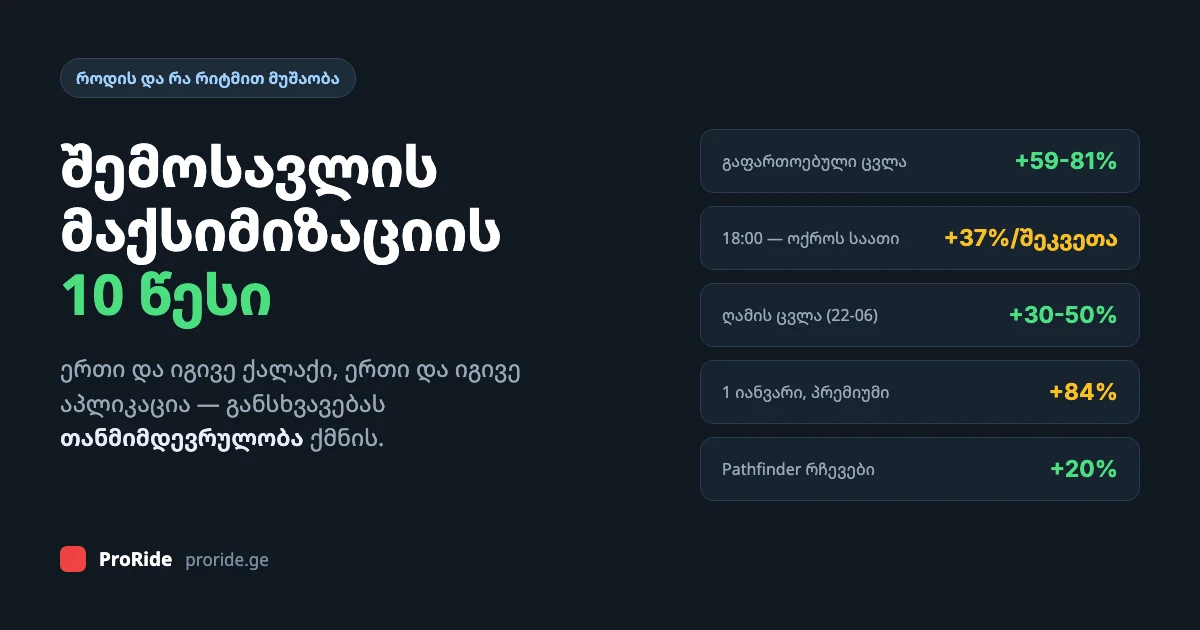
A split shift (morning + evening) yields 59-81% more earnings than evening-only work.
This is the most underutilized strategy out there.
With a split shift, you earn 59% more than working evenings only. The median difference is even more dramatic: +81%.
Same 8 hours. Radically different results.
At 8-9 AM, competition is minimal — few drivers are online, but commute orders are expensive. If you catch this window, you get a mid-day break and return with fresh energy for the evening peak.
You work when fares are high. You rest when the market is dead.
Try it for 1 week. Work 08:00-10:00, stop completely, then work 17:00-23:00. Compare your daily income to your usual schedule. The data says you'll see a 59-81% increase.
| Shift type | Difference |
|---|---|
| Morning (08:00-10:00) + Evening (17:00-23:00) | — |
| Evening only (17-23) | -37% |
| Morning only (08-10) | -53% |
| Random hours | -69% |
Want to see which hours earn you the most?
ProRide Driver App gives you detailed earnings analytics by hour, day, and category — in real time.
Rule #4: 18:00 — The Golden Hour
An order at 18:00 is 37% more expensive than one at 21:00. This is the most valuable time slot of the entire day.
If you could only work one hour per day — this should be the one.
An order at 18:00 is 37% more expensive than at 21:00. High demand, surge pricing, long rides home — passengers are willing to pay more to avoid waiting.
By 21:00, those premiums disappear. Short rides between bars, lower surge coefficients, and still plenty of drivers competing.
What TOP drivers do: they go online at 17:45 — not 18:15. The data shows that the first 30 minutes of the 18:00 hour are the most valuable time slot of the entire day.
Rule #5: 10:00-11:00 — The Lowest-Earning Hours
Hourly income at 11:00 is 36% lower than at 5:00 AM.
The data shows these hours pay the least.
Hourly income at 11:00 is 36% lower than at 5:00 AM.
The morning peak ends around 9:30. The lunch wave doesn't start until 12:30. This 2-hour window is often slow — the data shows that many drivers are online, but expensive orders are scarce.
Interesting fact: if you're online at 10:30 and wondering why work is slow — the data points to these exact hours as the lowest point of the day. Many TOP drivers take a break during this time and return at 17:00.
| Hour | What's happening |
|---|---|
| 11:00 | Many drivers online, few expensive orders |
| 10:00 | Morning peak is over, lunch wave hasn't started |
| 18:00 | Peak — passengers willing to pay more |
| 05:00 | Near-zero competition |
Rule #6: Thursday & Friday — Money Days. Sunday — Not.
Thursday orders are 16.5% more expensive than Sunday. If you need one day off — Sunday costs you the least.
Thursday orders are 16.5% more expensive than Sunday.
Our TOP driver works every day — including Sunday. But the data shows that if you need one day off — Sunday is when you'll lose the least.
If you can only work 5 days — Monday through Friday delivers the highest yield. If 6 days — adding Saturday is justified by the data. Sunday is statistically the lowest-earning day.
| Day | Best strategy |
|---|---|
| Thursday | Best price per order |
| Friday | Most orders available |
| Saturday | Volume day |
| Monday | Stable |
| Tuesday | Average |
| Wednesday | Average |
| Sunday | Rest day |
Rule #7: Holidays — A Gold Mine (If You Know Which Ones)
New Year's Day orders pay 84% more. But Valentine's Day — below average. The principle: the fewer drivers working, the more each one earns.
On holidays, most drivers stay home. Those who work — earn accordingly.
Very few drivers worked on January 1st. The result? 84% more per order compared to a regular day. Half the competition + surge coefficients = jackpot.
But beware the Valentine's trap! Many drivers came out expecting premium prices. So many showed up that earnings were actually lower than a regular day. Premium pricing only works when most drivers stay home.
What the data shows: on national and religious holidays, when few drivers work, earnings spike dramatically. On commercial holidays (Valentine's, etc.), many drivers come out and the premium vanishes. The principle is simple: the fewer drivers working, the more each one earns.
| Holiday | Premium | Active drivers |
|---|---|---|
| New Year (January 1) | +84% | Very few |
| January 2 | +41% | Few |
| New Year's Eve (December 31) | +24% | Few |
| Epiphany (January 19) | +22% | Few |
| Christmas (December 25) | +21% | Few |
| Valentine's Day (February 14) | -2% | Many |
Rule #8: Your Car's Year Determines Which Orders You Get
A 2020+ car on Comfort+ earns roughly 47% more per order than a pre-2010 car on Economy.
This is a data point nobody talks about.
A 2020+ car on Comfort+ earns roughly 47% more per order than a pre-2010 car on Economy — same distance, same time, same city.
But here's where the story gets interesting: a very good result is possible on an older, economical car too. The car raises the price of an order, but consistency decides more.
If you're planning to upgrade your car — prioritize a 2016+ model that qualifies for Comfort. A 10% difference per order adds up to thousands over a year of trips. If you have an electric vehicle (2020+) — you're already in the most profitable position: Comfort+ together with low fuel costs, provided you follow Rule #1 and #2.
| Car year | Comfort access | Difference |
|---|---|---|
| 2020 and newer | 91% | +26% |
| 2015-2019 | 85% | +4% |
| 2010-2014 | 37% | Baseline |
| Pre-2010 | 0% | Baseline |
Adding or switching a vehicle in ProRide takes one tap
Driver App shows your net earnings (commissions deducted), lets you manage your vehicle and cash orders — all in one place.
Rule #9: The Friday Night Premium — After Midnight
Drivers who keep working Fridays past 22:00 earn 67% more than those who stop before 20:00.
Friday night and the hours after midnight — this is where the real weekend premium orders are.
An interesting finding: Saturday evening is actually below average according to the data. The reason — many drivers come out, but high competition drives order prices down.
The premium orders are after Friday midnight. Clubs close, people need rides, surge coefficients kick in.
What TOP drivers do on Fridays: they start at 17:00 and keep going until 01:00-02:00 AM. Saturday evening is the weakest period according to the data, while late Saturday night (after midnight) shows strong earnings again.
| Time slot | Difference vs. normal |
|---|---|
| Saturday 00:00-03:00 (Friday night) | +10% |
| Sunday 00:00-03:00 (Saturday night) | +8% |
| Friday 18:00-23:00 | +4% |
| Saturday 18:00-23:00 | -4% |
Rule #10: Night Driving — The Most Profitable Shift
At 5:00 AM, hourly income is higher than any daytime hour. Night shifts deliver 30-50% more earnings.
Every hour from 22:00 to 06:00 outearns every daytime hour.
At 5:00 AM, competition is virtually zero and hourly income is higher than any other hour of the day. Compare that to 11:00 AM, where many drivers are fighting for orders and income is low.
That's a 56% premium reward for working when everyone else is asleep.
Night shifts aren't for everyone. But if you can handle it — this is the closest thing to a "Cheat Code" in this business.
Night shift example schedule: work 22:00-06:00, sleep 07:00-15:00, personal time 15:00-21:00. Same 8 hours as a day shift — but data shows 30-50% more income and significantly less competition.
| Hour | Competition |
|---|---|
| 05:00 | Minimal |
| 00:00 | Low |
| 23:00 | Medium |
| 02:00 | Low |
| 04:00 | Very low |
| 09:00 | Medium |
| 18:00 | High |
| 11:00 | High |
A Real TOP Driver's Schedule
Toyota Prius 2009. Works almost every day. No secrets — just relentless consistency.
We examined the exact schedules of our best drivers.
Toyota Prius 2009. Works almost every day.
Works primarily from 16:00 to 05:00 — a long evening-to-night shift. The heaviest hours are 22:00-02:00. Almost never works during the day.
Doesn't take days off. Doesn't pick favorite days. Shows up every day and works the evening-night shift.
Nothing complicated. No secret locations. No magic car. A 2009 Prius and relentless consistency.
| Day | Orders/day | Days off? |
|---|---|---|
| Saturday | 18.6 | Never |
| Thursday | 19.1 | Never |
| Wednesday | 18.7 | Never |
| Tuesday | 16.3 | Never |
| Friday | 15.8 | Never |
| Sunday | 15.8 | Often |
| Monday | 14.8 | Never |
Your Optimal Weekly Schedule
Based on all the data, here is the optimal week for an Economy-class vehicle:
Following all three rules together — consistent days, peak hours and the night shift — makes the biggest difference.
| Day | Hours |
|---|---|
| Monday | 08:00-10:00 + 17:00-23:00 |
| Tuesday | 08:00-10:00 + 17:00-23:00 |
| Wednesday | 08:00-10:00 + 17:00-23:00 |
| Thursday | 08:00-10:00 + 17:00-23:00 |
| Friday | 08:00-10:00 + 18:00-02:00 |
| Saturday | 17:00-01:00 |
| Sunday | Rest day |
Maximum Earnings (7 Days + Night Shift)
Want even more? Add the following:
- Work Sundays too — no days off
- Extend 2-3 days per week to 02:00-03:00 AM instead of stopping at 23:00 — night hours are the most profitable
- Work premium categories (Comfort+, Line) with a 2020+ car
Result: with an electric or new car and full consistency you reach the maximum these rules can give.
The Math in 3 Lines
These 3 rules make the biggest difference. A 2017+ car on Comfort+ raises the result further still.
Those who ignore all three — earnings stay minimal.
Same city. Same app. Different results.
- 1Work 25+ days/month instead of 10 → 13.5x more income
- 2Split shift instead of evening only → 59-81% more every day
- 312+ orders/day instead of 7 → You're in the TOP 20%
Ready to put these rules into practice?
ProRide offers AI goals, Leaderboard, detailed analytics — everything you need to become a TOP driver.
Bonus Tip: Pathfinder — 20% More Earnings with One Feature
Following Pathfinder's recommendations earns you an average of 20% more — "dead mileage" is reduced to a minimum.
Yandex's Pathfinder algorithm tells you where to go between orders — where the next demand will be.
Drivers who consistently follow Pathfinder's recommendations earn an average of 20% more.
Why? Without Pathfinder, the average driver spends a third of their online time idling or driving toward a passenger. This is zero-income time — nobody is paying you.
Pathfinder reduces this "dead mileage" — it shows you where to go before you even finish your current trip.
TOP drivers follow Pathfinder's recommendations almost every time — and the results speak for themselves.
Bonus Tip: Rating = Money
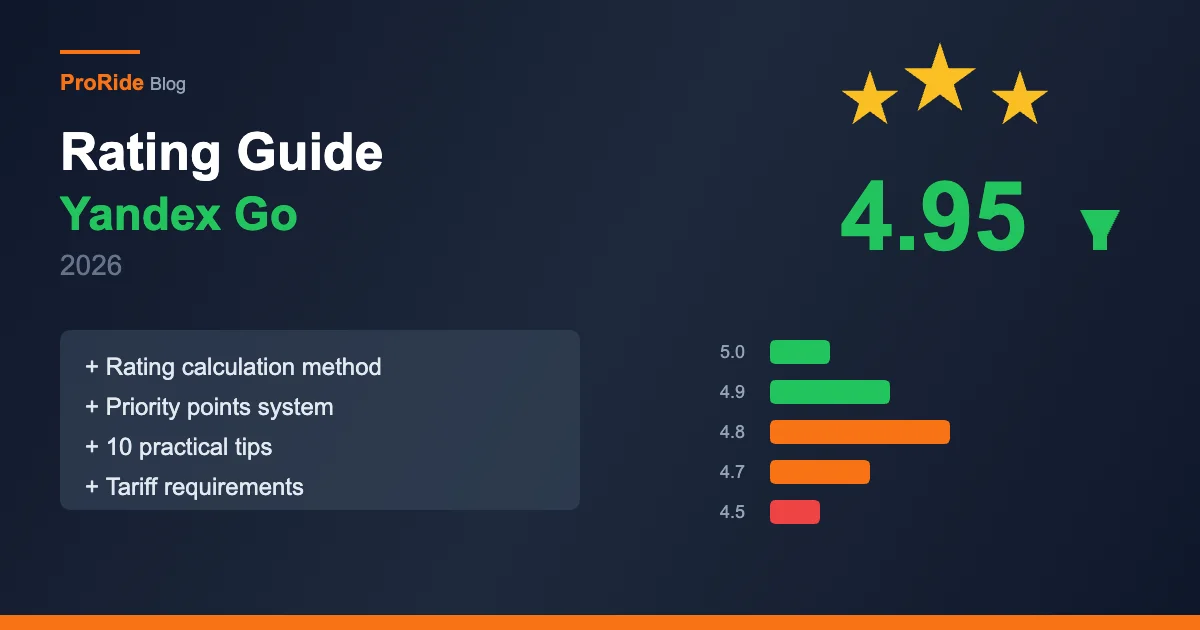
A driver with a 4.8 rating receives 10-15% more orders in the same zone than a driver with a 4.6.
Your rating directly affects how many orders you receive.
A driver with a 4.8 rating in the same zone, at the same hour — gets 10-15% more orders than a driver with a 4.6.
- Car cleanliness — every single day
- Smooth driving — no sudden maneuvers
- Respond to feedback in the Taximeter app
- Complete photo verifications on time
A rating drop from 4.8 to 4.6 may seem "insignificant," but by the end of the month it translates into hundreds of ₾ in lost earnings.
| Rating | What happens |
|---|---|
| Below 4.5 | Orders stop — effectively 0 income |
| 4.5-4.7 | Standard priority |
| 4.7-4.9 | Increased priority — more orders |
| 4.9+ | Maximum priority |
ProRide Driver App — Your Key Earnings Tool
ProRide drivers use driver.proride.ge — ProRide's own app for its drivers. This app was built with one purpose: to help you earn more.
- Real earnings — see your net profit with Yandex and ProRide commissions already deducted. No guesswork — you know exactly how much you keep
- Leaderboard — see where you stand compared to other drivers. Real-time ranking and a weekly TOP drivers list
- Vehicle management — add or switch your car directly in the app, without any bureaucracy
- Cash control — toggle cash payment orders on or off with a single button
- Detailed analytics — view your earnings trends by day, hour, and category
- AI goals — set a monthly earnings target and AI helps you reach it

Dashboard

Monthly Goal

Withdrawal

Fines

Services
Why ProRide?
ProRide drivers enjoy special conditions. The reason is simple:
- Weekly TOP-3 bonus — the best drivers receive cash prizes
- Full support — registration, documentation, technical assistance
- Transparent system — you see everything in real time
- Driver App that helps you make better decisions